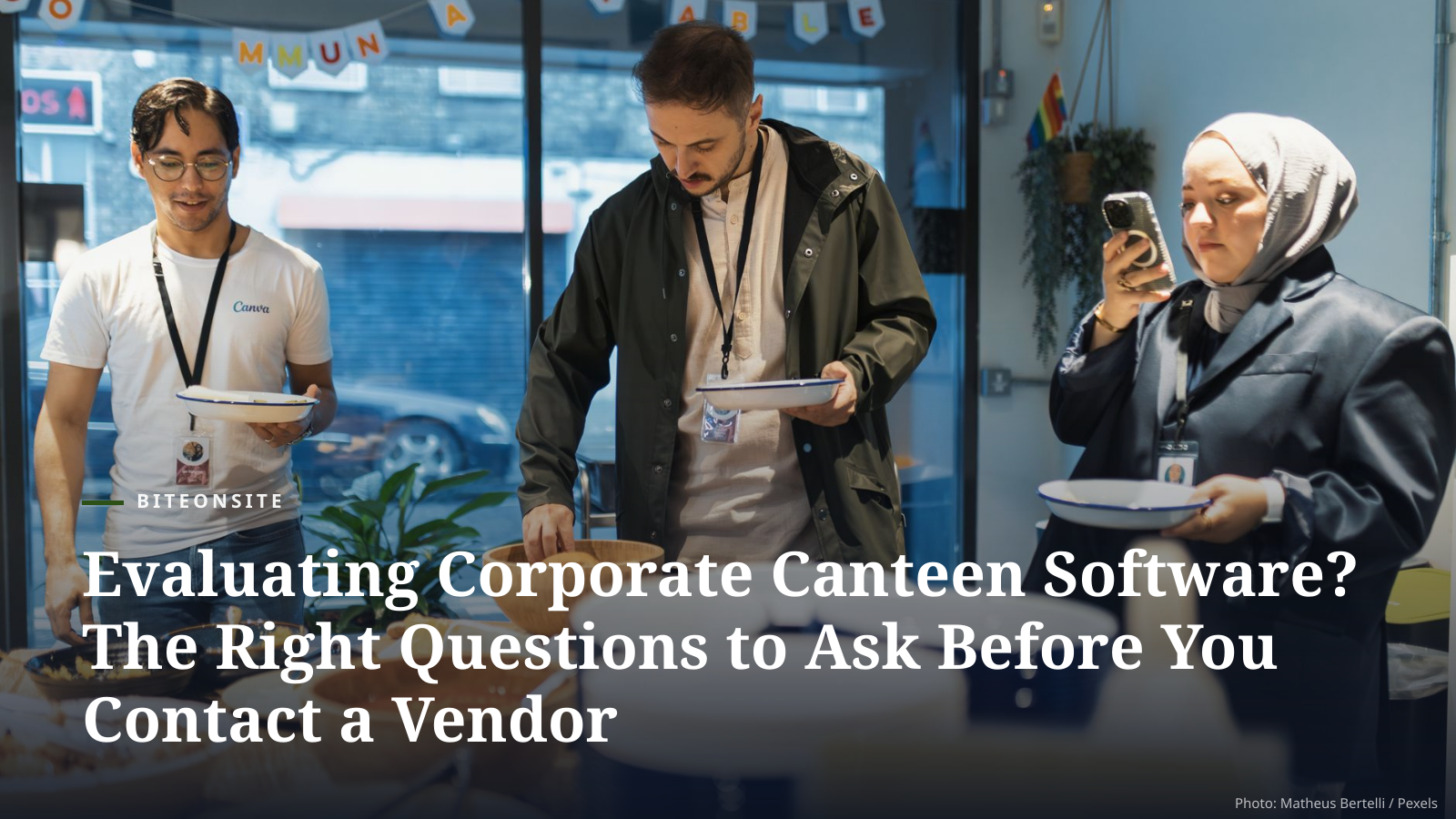
Evaluating Corporate Canteen Software? The Right Questions to Ask Before You Contact a Vendor
Evaluating Corporate Canteen Software? The Right Questions to Ask Before You Contact a Vendor
Most procurement teams approach corporate cafeteria vendors with a list of features. That is the wrong starting point. Features without operational context produce systems that look good in demos and underperform on site. Before you request a proposal, you need a sharper set of questions — ones that expose how a platform actually behaves across multiple locations, under load, and inside your existing workflows.
Here is a structured evaluation framework built for facility and HR operations leaders managing canteens as a workplace amenity and a cost-controlled procurement category.
1. Start With the Operational Baseline, Not the Feature Sheet
A corporate canteen is not a restaurant. The distinction matters more than vendors typically acknowledge. A canteen vs restaurant comparison comes down to volume, predictability, and employer accountability. Your canteen serves a captive audience in two or three service windows per day. Speed and consistency outrank menu variety. Your vendor must understand that difference before they pitch anything.
Ask every vendor these baseline questions first:
How many corporate canteen sites do you currently operate across South Africa?
What is your average transaction throughput per service window at a 300-seat site?
Can your system enforce employer-configured meal subsidies, allowances, or canteen voucher balances in real time at the point of sale?
How does your platform handle a site with three service counters and different menu stations?
If a vendor hesitates on any of these, they are likely adapting a hospitality or retail product to fit a canteen environment. That adaptation creates gaps you will discover at go-live, not during the sales process.
2. Interrogate the Canteen POS System for South African Conditions
South Africa presents infrastructure challenges that vendors headquartered elsewhere routinely underestimate. Load shedding is the most consequential. A canteen POS system that requires continuous internet connectivity will fail during Stage 4 and above — precisely when your staff are queuing and your service window is shortest.
Ask every vendor:
Does your POS operate in fully offline mode, including canteen voucher redemption and subsidy deduction?
How does transaction data sync once connectivity is restored — automatically, manually, or selectively?
What is your hardware specification for a South African site running on UPS or generator power?
Have you documented uptime performance during load shedding periods across your existing client base?
A credible canteen POS vendor operating in South Africa will have clear answers and reference sites you can contact. A vendor that pivots to "our cloud infrastructure is highly redundant" has not properly addressed the last-kilometre connectivity problem that affects your canteen floor.
3. Test the Pre-Order and Queue-Reduction Capability
Pre-ordering is the single most effective operational lever in a high-volume workplace restaurant or canteen. When employees order thirty to sixty minutes before service, your kitchen plans accurately, your queue shortens, and your wastage drops. The catering ordering system behind pre-order must be configurable to your meal windows, cut-off times, and site-specific menus.
Ask:
Can employees pre-order via mobile app, desktop browser, and kiosk, and does the canteen POS system reconcile all three channels at collection?
Can cut-off times and menu availability be configured per site, per day, and per service period?
How does the system handle a bulk pre-order from an HR manager covering a 50-person executive lunch?
Does pre-order data feed directly into kitchen production reporting, or does it require manual export?
Consider this practical example. A financial services firm running five canteen sites in Johannesburg and Cape Town implemented pre-ordering with a 45-minute cut-off. Within 90 days, average queue time at peak service dropped from eleven minutes to under four minutes. Wastage on hot meals reduced by 22 percent because the kitchen cooked to confirmed orders rather than projected headcount. That outcome was only possible because the catering ordering system was natively integrated with the canteen POS — not bolted together through a third-party connector.
4. Demand Multi-Site Reporting Before You See a Demo
Single-site demos are unreliable indicators of enterprise capability. Any vendor can configure one site to look polished. What you need to see is consolidated reporting across all your locations with site-level drill-down, exportable data in formats your finance team already uses, and role-based access that matches your organisational structure.
Specific questions:
Can I see a live dashboard that aggregates canteen voucher redemption, subsidy spend, and transaction volume across all my sites simultaneously?
How is reporting structured for an HR manager at one site versus a national operations director?
Can the system produce a monthly cost-per-head report broken down by cost centre, department, or employee grade?
What is your data retention policy, and how far back can I query historical transaction data?
If a vendor cannot demonstrate multi-site reporting in a live environment — not a slide deck — that is a red flag. Consolidated reporting is not a premium add-on. It is a minimum requirement for any organisation managing canteens as a procurement category.
5. Clarify Integration, Support, and Escalation
A catering ordering system that does not integrate with your HR or payroll platform creates double-handling. Canteen voucher balances that require manual top-up by an administrator every month create risk and delay. Ask vendors to specify exactly which integrations are native, which are available via API, and which require custom development at your cost.
On support, be direct:
What is your support hours model — business hours only, or 24/7 for POS faults?
Do you have technicians on the ground in the provinces where my sites operate?
What is the average response time for a POS-down incident during a service window?
These are not administrative details. A canteen POS system that goes down at 12:15 on a Wednesday affects several hundred employees and creates a reputational problem for your HR and facilities team within the hour.
Before You Contact Any Vendor, Know What You Are Buying
Corporate canteen software is not a commodity purchase. The wrong system creates queue problems, reporting gaps, subsidy leakage, and load-shedding failures that are expensive and disruptive to fix mid-contract. The right system gives you consistent service across every site, accurate spend data every month, and a pre-order channel that your employees will actually use.
BiteOnSite works with multi-site corporate clients across South Africa to deploy canteen management platforms built for the operational realities of a workplace restaurant — including offline POS capability, canteen voucher management, and consolidated reporting from day one. If you are ready to evaluate vendors with the right questions already answered, speak to our team. We will show you exactly how the platform performs across your site configuration before you commit to anything.